DevOps Consulting, Done Right.
CI/CD that doesn't block deploys. Cloud bills that don't grow unchecked. Infrastructure that holds under load. A senior DevOps engineer — not a managed-services desk — working directly on your stack.
How a DevOps
engagement works
What DevOps Consulting Actually Covers
Not a ticket queue. A working infrastructure.
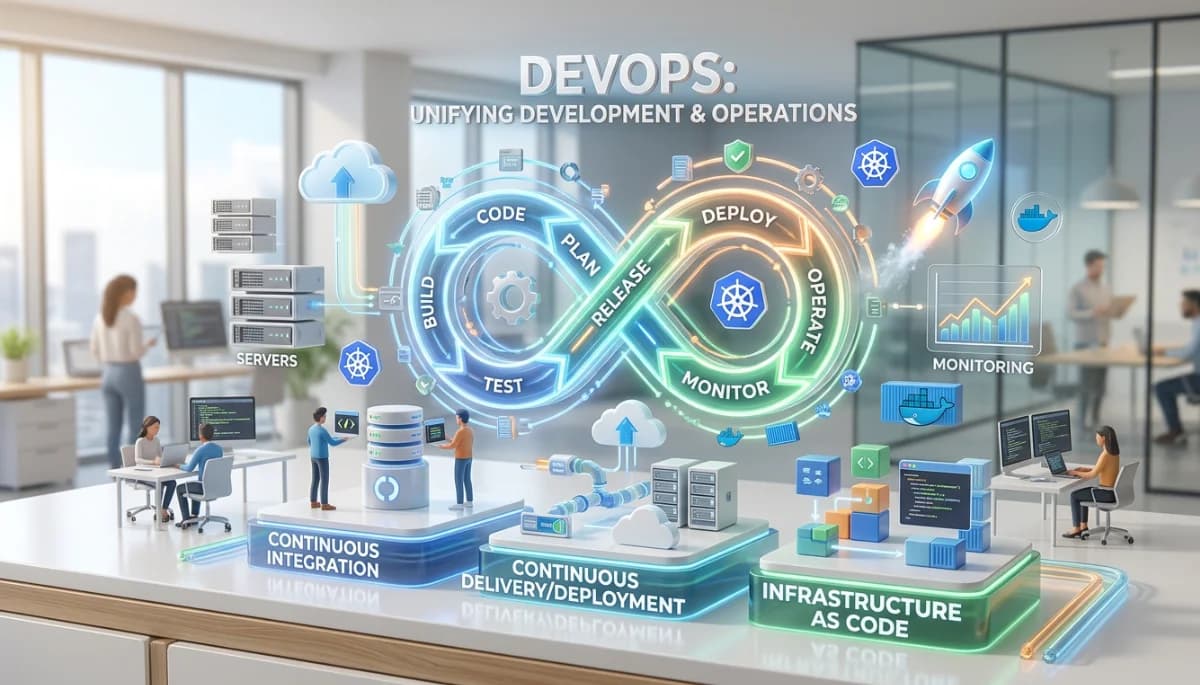
DevOps consulting means getting the systems around your code into a state where they help rather than hinder. That covers CI/CD pipelines (build, test, deploy — automated and reliable), infrastructure as code (reproducible environments, no manual snowflake servers), cloud cost management (finding and eliminating the waste that accumulates over time), scaling and reliability (what happens when load spikes), observability (structured logs, metrics, alerting that fires on real problems), and incident response (runbooks, on-call setup, post-mortems that actually change something). The scope of any engagement is set upfront. An audit gives you a full picture of where the problems are and what fixing them costs. Implementation follows if you want it — same engineer, no handoffs.
Proven outcomes: 40% cloud-bill reduction in one sprint; Black Friday at ~12,000 concurrent users without incident; DietGhar zero-downtime PM2 rolling deploys.
Includes
- — CI/CD pipeline audit and rebuild (GitHub Actions)
- — Infrastructure as code review and implementation
- — Cloud cost audit — itemised findings, not a summary
- — Scaling review: connection pooling, caching, autoscaling
- — Observability setup: CloudWatch, structured logging, alerting
- — Incident response: runbooks, on-call, post-mortem process
Best forEngineering teams whose infrastructure has outgrown how it was set up.
TimelineAudit delivered within 1 week; implementation scoped per project
How an Engagement Works
Audit first, roadmap second, implementation third.
It starts with a 30-minute call. You describe the pain — slow deploys, rising AWS bill, a scaling incident that keeps happening — and I ask the questions needed to scope the audit. From there: an infrastructure audit is the first deliverable, usually within a week. It covers your current state, the gaps, and a prioritised list of fixes with effort estimates. You can take that roadmap and hand it to your team, or I can implement it. Implementation is staged: the highest-impact changes first, reviewed at each milestone before the next begins. A real example: a client's cloud bill was running 40% higher than it should. The audit identified oversized instances, on-demand pricing where reserved capacity applied, and several idle resources. The fixes were applied in a single sprint. For scaling: a 2-million-product e-commerce platform moved off Magento, survived Black Friday at ~12,000 concurrent users. PgBouncer transaction pooling reduced 8,000 app connections to 150 database connections — 4x throughput from the same database tier.
Findings are written, not verbal. You get a document you can act on whether or not you engage further.
Includes
- — Written infrastructure audit with prioritised findings
- — Fixed-scope proposal within 48 hours of scoping call
- — Staged implementation with review at each milestone
- — Async updates — no mandatory status meetings
- — Full documentation and runbooks on handover
Best forTeams that want a clear picture before committing to a full engagement.
TimelineAudit delivered within 1 week of kick-off
Why a Solo Senior Engineer
You talk to the person who touches the infrastructure.
Managed-services contracts give you a support desk. Agencies give you a project manager and a rotating team. Neither gives you the senior engineer directly. Here, one person scopes the work, does the audit, writes the IaC, and is accountable for the outcome. If something breaks after a change I shipped, I fix it — there is no handoff to a different team. The tradeoff is that I take a limited number of projects at once. NyayX runs on AWS ECS with multi-tenant PostgreSQL (row-level security), AES-256 encryption at rest, S3 document storage, Redis, and an append-only audit trail. DietGhar uses Node.js microservices with PM2 clustering and zero-downtime rolling deploys. Both were built and are maintained by the same engineer you'd be working with. A monthly retainer is available for teams that want ongoing cover: a set number of hours per month, priority response, and a direct line when something breaks at 2am.
Named accountability: one engineer owns the outcome, start to finish. No intermediaries.
Includes
- — AWS infrastructure (ECS, Lambda, RDS, ElastiCache, S3, CloudWatch)
- — GitHub Actions CI/CD pipelines
- — IaC-style configuration and environment management
- — PgBouncer and Redis for connection and caching layers
- — Zero-downtime deployment strategies
- — 30-day post-engagement support
Best forTeams tired of raising tickets to a support desk to fix infrastructure problems.
TimelineRetainer available after initial engagement; ongoing monthly
Typical stack
- AWS (ECS, Lambda, RDS, S3)Primary cloud
- GitHub ActionsCI/CD pipelines
- Terraform / IaCReproducible environments
- DockerContainer builds and orchestration
- PgBouncerPostgreSQL connection pooling
- RedisCaching and queue layer
- CloudWatch / structured loggingObservability
Based in India, working async-first with clients in the US, UK, UAE, and Australia. IST timezone — most async threads don't need a call at all. When they do, we find a window that works.
What does a DevOps consultant do?
A DevOps consultant reviews and improves the systems that surround your code: CI/CD pipelines, cloud infrastructure, container orchestration, observability, incident response, and cost management. In practice that means diagnosing what is slow, brittle, or expensive — then fixing it. That might be rebuilding a flaky pipeline that blocks deploys, cutting a cloud bill that grew unattended, or setting up alerting so the team finds out about failures before users do. The output is working infrastructure you understand and own, not a slide deck.
Can you cut our cloud bill?
Yes, and meaningfully. In one sprint I cut a client's cloud bill by 40% through rightsizing instances, switching eligible workloads to spot and reserved capacity, cleaning up idle resources, and reducing unnecessary egress. The typical levers are: oversized instances, on-demand pricing where RIs or Savings Plans apply, forgotten resources (old snapshots, unused load balancers, orphaned volumes), and egress charges from suboptimal architecture. A cloud cost audit gives you the itemised picture; implementation follows immediately if you want it.
Do you do one-off audits or ongoing work?
Both. A one-off engagement typically starts with an infrastructure audit — a structured review of your CI/CD, cloud spend, and reliability posture — followed by a prioritised roadmap. You can stop there and hand it to your team, or I can implement the fixes. For teams that want ongoing cover, a monthly retainer gives you a set number of hours each month with priority response. Most clients start with a scoped project and add a retainer once they see the output.
Which cloud providers do you work with?
Primarily AWS, where most of my production experience sits — ECS, Lambda, RDS, ElastiCache, S3, CloudWatch, and cost tooling. I also work with Vercel and Railway for application hosting, and the CI/CD and IaC patterns I use (GitHub Actions, Terraform) are largely provider-agnostic. If your stack is GCP or Azure, I can audit and advise but would be transparent about where AWS is my deeper domain.
How fast can you start?
A 30-minute scoping call can usually happen within a few days. From there, a written proposal arrives within 48 hours. For urgent situations — a scaling incident, a pipeline that is blocking the team, a cost spike — I can often start an audit the same week. I take a limited number of projects at once; if I'm at capacity I'll tell you in the first call rather than overcommit.
Related: MVP Development · Hire a Next.js Developer · Hire a Node.js Developer · DevOps Best Practices
Infrastructure problems tend to compound. If your CI/CD, cloud costs, or reliability posture needs attention, start with a 30-minute call.
Book a scoping call